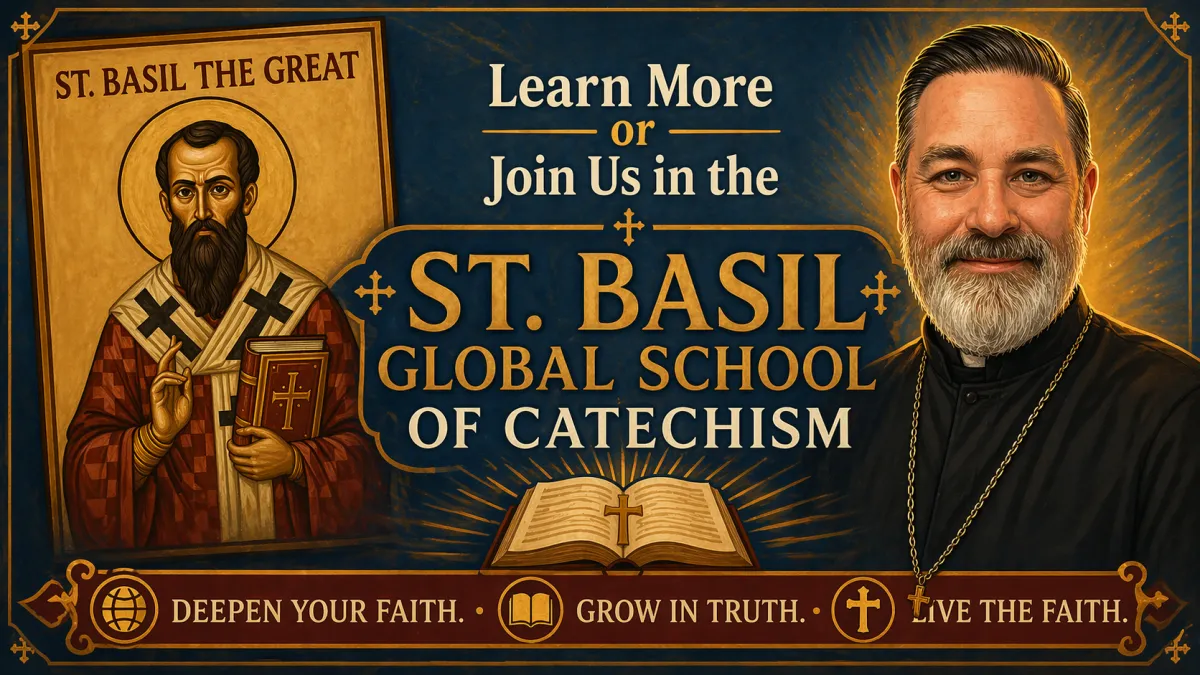
Discover the Ancient Faith That Transforms the Heart
A Safe, Welcoming Community for Those Exploring Holy Orthodoxy
Have you felt drawn toward something deeper—something ancient, sacred, and unchanging?
Perhaps you’ve read the Church Fathers, glimpsed the beauty of the Liturgy, or felt the pull of timeless truth…
But you don’t have a priest to ask.
You don’t have an Orthodox parish nearby.
Maybe, you’re not ready to walk through those doors—yet.
Or, you want to dive deeper into your Orthodox faith.
Still, you're looking for a community where Christ is present and transformation happens in a safe place.
Welcome home. This is your starting point.
The Ladder of Divine Ascent: Spiritual Reality, Warfare, and the Healing of the Soul
A 16-Week Advanced Formation Program with Father Don Purdum
Something is wrong and you already know it.
You've read the books. You've listened to the podcasts. You've sat through sermons that made you feel something for about 45 minutes before real life swallowed you whole again.
And yet...
You're still anxious. Still scattered. Still waking up at 2AM with a low-grade dread you can't name and can't shake. Still wondering why your spiritual life feels like you're running on a treadmill set to a speed you can't keep up with.
Here's what nobody in your church, your prayer group, or your favorite YouTube channel is telling you:
You're not failing at Christianity.
You've just never been given the actual map.
The one the saints used.
The one the Desert Fathers bled for.
The one that's been sitting in plain sight for 1,400 years while modern Christianity quietly replaced it with motivational talks and emotional experiences.
The Ladder of Divine Ascent by St. John Climacus isn't a devotional.
It's not a self-help book dressed in ancient language.
It's a clinical diagnosis of what's actually happening inside you — and a brutally honest prescription for what to do about it.
And Father Don Purdum is going to walk you through every single rung.
Here's The Problem With How Most People Approach Spiritual Growth
They treat it like a behavior modification project.
Read more. Pray more. Try harder. White-knuckle your way through temptation and hope God notices the effort.
That approach has a name in the patristic tradition. It's called missing the point entirely.
The Fathers understood something that modern Christianity has largely forgotten: you are not just a body with a soul bolted on. You are an integrated being — nous, heart, mind, body — living in a cosmos that is drenched in spiritual reality.
And that reality includes forces that are actively working against your healing.
Not metaphorically. Not symbolically.
Actually.
The reason your prayer life feels dead isn't because you need a better devotional plan.
The reason your anger keeps erupting isn't because you haven't found the right coping strategy.
The reason anxiety has its hooks in you isn't because you need more therapy (though therapy has its place).
The reason is that you're in a war you were never trained to fight.
And you can't win a war you don't even know you're in.
What This 16-Week Formation Program Actually Is
This isn't a reading plan you'll abandon by week four.
This isn't a theological lecture series where you take notes, nod along, and change nothing.
This is a formation program — structured around the ancient three-stage path of purification, illumination, and union — designed to do something to you, not just teach you something.
Father Don Purdum has spent years integrating patristic theology, the reality of spiritual warfare, and an unflinching understanding of modern psychological struggles into his teaching.
He doesn't separate the spiritual from the physical.
He doesn't pretend the unseen realm is an optional add-on to "practical" Christianity.
Because the Fathers didn't separate them either.
Over 16 weeks, you'll move through all 30 Steps of The Ladder — not as an academic exercise, but as a guided confrontation with the interior chaos most people spend their entire lives avoiding.
Phase I: Orientation & Ontology (Weeks 1–3)
What is reality? What is the human person? Where is the actual battle?
Before you can climb the Ladder, you need to see the world the way the saints saw it.
Not the flattened, materialist version the Enlightenment handed you. Not the sentimental, feelings-first version popular Christianity has been selling.
The real one.
The one where the physical and spiritual are inseparable.
Where every moment of your day is taking place on a battlefield you've been trained since childhood to ignore.
Week 1 opens with Steps 1–3 — Renunciation, Detachment, and Exile — and immediately reframes the "world" not as geography, but as a spiritual system. Father Don integrates cultural critique here, exposing how secularism functions as a kind of practical atheism that has quietly shaped even devout believers.
Week 2 digs into anthropology.
What are you, actually? Not the fragmented, ego-driven self that modern psychology describes. Not the disembodied soul that bad theology implies. The integrated person — nous, heart, mind — and the critical distinction between the false self you've constructed and the true self hidden in Christ.
Week 3 tackles what might be the most countercultural step on the entire Ladder: obedience. In a culture addicted to autonomy and allergic to authority, Climacus makes a claim that sounds insane to modern ears — that surrendering your will to a spiritual father isn't weakness. It's the beginning of healing.
Father Don unpacks why, drawing parallels between therapeutic surrender and the ancient practice of spiritual obedience. This isn't about blind submission. It's about recognizing that the fragmented self cannot heal itself.
Phase II: Purification (Weeks 4–8)
Healing the passions. Confronting the interior chaos.
This is where it gets uncomfortable.
Most spiritual programs skip this part or rush through it because it doesn't feel good. It doesn't produce Instagram-worthy transformation stories.
It produces tears.
Confusion.
The sickening realization that the "you" you've been presenting to the world — and to God — isn't actually you.
Week 4 redefines repentance.
Not as guilt management.
Not as a repeated apology loop.
As ontological rebirth — a complete reorientation of your being. Climacus pairs this with the memory of death, and Father Don explores why modern culture's denial of death has crippled our capacity for genuine repentance.
Week 5 enters territory that trips up almost everyone: the difference between spiritual mourning and clinical depression. Between godly grief and the demonic counterfeit of discouragement designed to make you quit.
This distinction matters more than you think, because misidentifying what's happening inside you leads to the wrong response every single time.
Week 6 takes on anger — and it's not what you expect. Climacus doesn't say anger is evil. He says anger is energy. Neutral energy. And the direction you point it determines whether it becomes righteous indignation or the slow poison eating your relationships alive.
Father Don connects this to the outrage cycles of modern culture, social media, and the way most people have mistaken being perpetually offended for being passionate.
Week 7 might be the most relevant week for anyone living in the 21st century. Acedia.
The "noonday demon."
The ancient name for the spiritual condition that looks almost identical to what we now call burnout, chronic distraction, and the inability to sustain attention on anything that matters.
St. John Climacus wrote about this 1,400 years ago.
Father Don brings it into the age of infinite scrolling, dopamine hits, and the quiet desperation of a soul that can no longer be still.
Week 8 goes where most teachers won't. Desire, sexuality, and the fragmented self.
Not a morality lecture.
Not a list of rules.
A patristic understanding of desire as misdirected longing for God — and how addiction frameworks, while useful, only describe the surface of a problem the Fathers diagnosed at the root centuries ago.
Phase III: Warfare of the Mind (Weeks 9–12)
Logismoi, fear, pride, and the invisible war.
If Phase II is the diagnosis, Phase III is where you learn to fight.
The patristic tradition has a word — logismoi — for the thought-patterns that assault the mind. Not random mental noise. Strategic, targeted, personalized attacks designed to pull you away from God and into spiraling cycles of fear, fantasy, and self-destruction.
Modern psychology calls some of these "intrusive thoughts" and treats them as neurological misfires. The Fathers had a different — and far more complete — understanding.
Week 9 introduces the mind as a battlefield.
Father Don walks through the mechanics of how logismoi work, how to identify their source (divine, human, or demonic), and why the inability to distinguish between your own thoughts and spiritual suggestion is one of the most dangerous blind spots a person can have.
Week 10 addresses fear and anxiety — not with platitudes about "trusting God more," but with a patristic framework that identifies fear as a distortion of reality. A warped perception. And faith not as an emotional feeling, but as ontological stability. The ground beneath your feet when everything feels like it's collapsing.
Week 11 confronts pride. The big one. The Luciferic pattern that Climacus identifies as the root beneath every other passion. Father Don connects this to modern identity formation, the culture of self-exaltation, and the terrifying reality that pride doesn't just hide in arrogance — it hides in religious devotion, in theological knowledge, in the very act of climbing the Ladder itself.
Week 12 is about discernment. The "science of the saints." The ability to perceive the difference between divine movement, human impulse, and demonic manipulation in real time. This isn't mystical hand-waving. It's a skill. It's trainable. And it requires a healed nous — which is exactly what the previous 11 weeks have been preparing you for.
Phase IV: Illumination & Healing (Weeks 13–14)
Reintegration of the person. Inner stillness.
By this point, something has shifted. Not because you've "completed a program," but because confrontation with truth — real truth, the kind that burns — always changes you.
Week 13 enters the territory of hesychia — inner stillness. Not mindfulness. Not meditation techniques borrowed from traditions that don't share the same anthropology. Orthodox hesychasm is something different entirely. It's the reclamation of attention. The refusal to let the chaos of the world colonize your interior life.
Father Don draws a sharp line between the modern "wellness" version of stillness and what the Fathers actually meant. This distinction is critical, because getting it wrong doesn't just waste your time — it can lead you somewhere spiritually dangerous.
Week 14 reframes prayer. Not as a technique. Not as a transaction. Not as a self-improvement tool. As union. As the experience of God — not merely knowledge about God. Climacus makes a claim here that separates the tourists from the pilgrims: true theology is not the ability to talk about God. It's the ability to stand in His presence.
Phase V: Theosis & Completion (Weeks 15–16)
Union with God. Transformation into love.
Week 15 arrives at apatheia — dispassion — and immediately corrects what almost everyone gets wrong about it. This is not emotional numbness. This is not Stoic detachment. This is freedom. The passions that once controlled you, directed you, jerked you around like a puppet — they've been healed. Not suppressed. Not managed. Healed. Through divine love.
Week 16 is the summit. Love. Not sentimentality. Not warm feelings. Love as the ontology of God Himself. Love as participation in divine life. Love as the end of spiritual warfare — not because the war stops, but because the warrior has been so transformed that the weapons of the enemy no longer find a foothold.
This is theosis. This is what the entire Ladder has been pointing toward.
And it's not a concept to understand.
It's a reality to inhabit.
Who This Is For
This is for the person who knows — somewhere deep, in that place they don't talk about — that something fundamental is missing from their spiritual life.
Not more information. Not more enthusiasm. Not another conference or book recommendation.
Formation. Real formation. The kind that confronts you, breaks you open, and rebuilds you from the inside out.
If you've been coasting on surface-level Christianity and you're tired of it...
If you've sensed that the spiritual realm is real but nobody around you takes it seriously...
If you've been battling the same patterns — anger, anxiety, lust, pride, despair — for years and nothing has produced lasting change...
If you're ready to stop managing symptoms and start addressing the root...
Father Don Purdum built this formation program for you.
Who This Is NOT For
If you're looking for feel-good content that affirms you exactly where you are, this isn't it.
If you want a passive listening experience you can half-pay-attention to while you fold laundry, this isn't it.
If you're uncomfortable with the idea that spiritual warfare is real, that demons are real, that the unseen realm actively shapes your daily experience — this is going to challenge you in ways you might not be ready for.
That's not a dare. That's honesty.
The Ladder of Divine Ascent has been transforming souls for over a millennium. But it's not gentle. Climacus wasn't gentle. And Father Don respects you enough to teach it the way it was meant to be received.
With clarity. With depth. Without apology.
16 Weeks. 30 Steps. One Ladder.
The saints climbed it. The Fathers taught it. The Church has preserved it for 1,400 years.
Now it's your turn.
Enroll in The Ladder of Divine Ascent: Spiritual Reality, Warfare, and the Healing of the Soul.
Your move.
P.S. — Most people will read this page, feel something stir inside them, and then close the tab. They'll tell themselves they'll come back to it later. They won't. If something in you recognized itself in these words, that recognition isn't accidental.
Don't ignore it.
You are invited
FREE: Want To See What You Get Every Week As A Member?
Here is the full Lesson 1 on the Ladder of Divine Ascent Titled, "Reality Itself Is Spiritual: Recovering the Lost Worldview"
What Is This Community About?
This isn’t just another online group.
Father Don Purdum will guide your journey into the mind and heart of the Orthodox Church—a place where ancient faith meets modern seekers.
Every discussion is rooted in Scripture, Tradition, and prayer—not debate or division.
JOIN THE JOURNEY NOW!!!
Come and see for only $10 per month!
Every week, Father Don releases a new prerecorded lesson you can watch whenever it suits you.
Plus, you get the entire back catalog: every lesson ever taught inside the Global Catechism, including the complete series on the Nicene Creed, The Unseen World (Enchantment), and The Ladder of Divine Ascent.
Whether you’re just curious or deeply searching, you’re invited to learn, ask, and grow with others who share your hunger for truth.
This is your opportunity to explore Orthodoxy with guidance, grace, and genuine fellowship.
Start learning. Start asking. Start transforming.